What missed calls actually cost a small UK business
Most service businesses do not lose work to bad service. They lose it to the call that rang out while someone was up a ladder, halfway under a sink, or driving between jobs with both hands on the wheel. The phone rings, nobody can reach it, and the thought that follows is reasonable enough: they will call back, or I will call them this evening. Sometimes that is exactly what happens. The cost worth understanding is not in any single missed call. It is in the pattern, repeated quietly week after week, that nobody ever sits down and adds up.
What actually happens to the calls
The phone is still how most customers get in touch. In a survey of 1,000 UK businesses, 56% said the phone was the most popular way customers contacted them, and 45% of inbound calls generated a new enquiry 1. So a ringing phone is not background noise. Close to half the time, it is a potential job.
The honest question is what share of those calls actually reach a person. The most detailed public count comes from a US study that monitored calls to 85 small businesses across 58 industries over 30 days. It found that only 37.8% of calls were answered by a person. Another 37.8% went to voicemail, and 24.3% got no response at all, which means 62% of calls never reached a human being 2.
It is fair to ask how well a US figure travels. The nearest UK number comes from a 2015 study of 142 small businesses, which found that 47% missed the initial call, while those running a call-answering or reception service answered around 85% 3. That study was commissioned by a company that sells call answering, and the sample is small, so it is worth treating as a signpost rather than a settled fact. It is worth being plain about this throughout: a lot of the available data comes from firms that sell the solution. That is exactly why every figure here is attributed, so a reader can weigh the source. Even read sceptically, the two studies point the same way. A large share of calls to small businesses do not reach anyone.
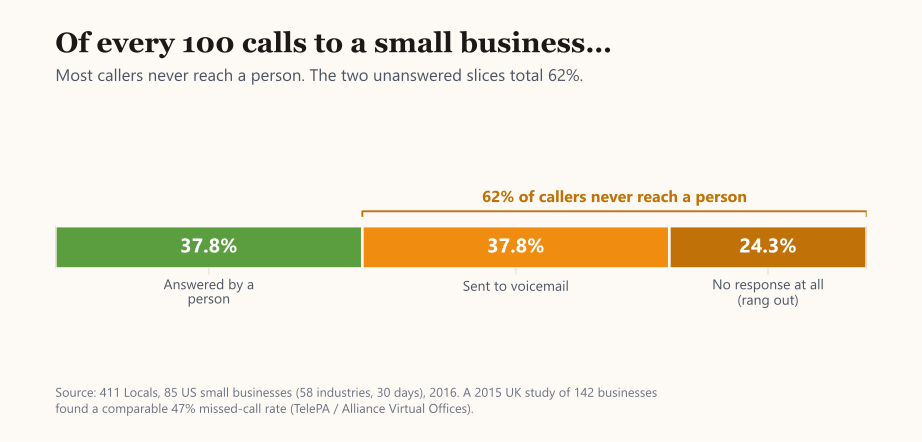
Of every 100 calls to a small business, most never reach a person. The two unanswered slices total 62%.
The two unanswered slices are the number worth sitting with. Most of a missed call’s cost is not the missed call. It is what the caller does next.
The maths most businesses avoid sitting down with
The point of the rate is to turn it into money, using a business’s own numbers rather than a borrowed percentage. Here is a worked example. The figures are illustrative, chosen to be plausible for a small trade rather than measured from any one firm, so the method matters more than the total.
Take a business that gets 100 inbound calls in a month. Suppose, in line with the studies above, that roughly 25 of them ring out or land in voicemail. Of those, not all are new work: some are suppliers, some are existing customers, some are wrong numbers. Say half are genuine new enquiries, so around 12 a month.
Now the part that decides whether a missed call costs anything. Of callers who reach voicemail, about 69% hang up without leaving a message 1. They do not wait. Many are calling precisely because the matter is urgent or because they want the reassurance of a person: 42% call needing an urgent response, and 40% for the reassurance of speaking to someone 1. A voicemail box answers neither of those. So most of those 12 enquiries are not parked for later. They are gone, often to the next number on the list.
Put a value on the work. A plumber’s call-out in the UK runs around £110, with a day’s work closer to £350 5. If even a third of those 12 lost enquiries would have converted, and a converted job is worth somewhere between a single call-out and a day’s labour, the monthly leak runs from a few hundred pounds to over a thousand, which is several thousand a year. The figure swings with every assumption, which is the honest point: it is a leak sized by the business’s own call volume, conversion, and job value, not a headline number that applies to everyone.
And the worked sum understates it, because it only counts the first job. A first job that never happens is also the repeat job that never follows, and the referral the customer never makes because they never became a customer. That tail is real but hard to pin to a number, so it is better named than invented.
When the calls get missed
The misses are not a sign that anyone is slacking. They are structural. The calls land at the times a small team is least able to answer: mid-morning when everyone is on site, late afternoon when the day’s work is being finished, the evening after a customer has got home and remembered the dripping tap, the bank holiday weekend. UK businesses are fielding more calls than they used to, around 34% more than five years earlier even as person-to-person calling fell, so the pressure is rising rather than easing 1.
Trying harder does not fix a structural gap. Voicemail is the usual fallback, and the 69% who never leave a message show how little it catches 1. A partner or an office manager covering the phone works until it does not: until they are on another line, off sick, or it is half past six. The useful question is not how to answer more calls in person, which has a ceiling, but what happens to the call when, honestly, nobody can pick it up.
What a different approach looks like
Closing the gap is less about answering everything in person and more about making sure no call goes nowhere. In practice that means three things. Every call is answered, whatever the time and whoever is busy. The caller’s details and their reason for calling are captured rather than lost. And the response is quick and personal, a text or an email back within minutes, rather than a cold callback hours later when the customer has already booked someone else.
Speed is doing more of the work here than it looks. A widely cited study of online enquiries found that responding within five minutes rather than thirty made a contact dramatically more likely, and qualifying the enquiry many times more likely again 4. That study looked at web-form leads in 2007, not phone callbacks, so it is best read as evidence about response speed in general rather than a precise multiplier for missed calls. The principle holds regardless: the first business to respond well to an enquiry has a real advantage, and the gap between minutes and hours is where a lot of work is won or lost.
This is the part hirevolution helps with: covering the calls a small team cannot take, capturing the lead, and getting a personal response back fast, so a busy day on the tools stops quietly costing new work.
Worth a closer look
See how hirevolution approaches missed calls and lead handling
Sources
- Moneypenny / Censuswide, ‘The Value of a Call Report’ (survey of 1,000 UK businesses), 2019. [link]
- 411 Locals study of 85 US small businesses (58 industries, 30 days), 2016. [link]
- TelePA / Alliance Virtual Offices study of 142 UK businesses, 2015 (47% missed-call rate; vendor-commissioned, small sample). [link]
- Oldroyd, McElheran & Elkington, ‘The Short Life of Online Sales Leads’, InsideSales / MIT Sloan, 2007 (web-form leads). [link]
- Checkatrade plumber cost guide, 2026 (illustrative UK call-out and day-rate figures). [link]