The true cost of downtime for a small business
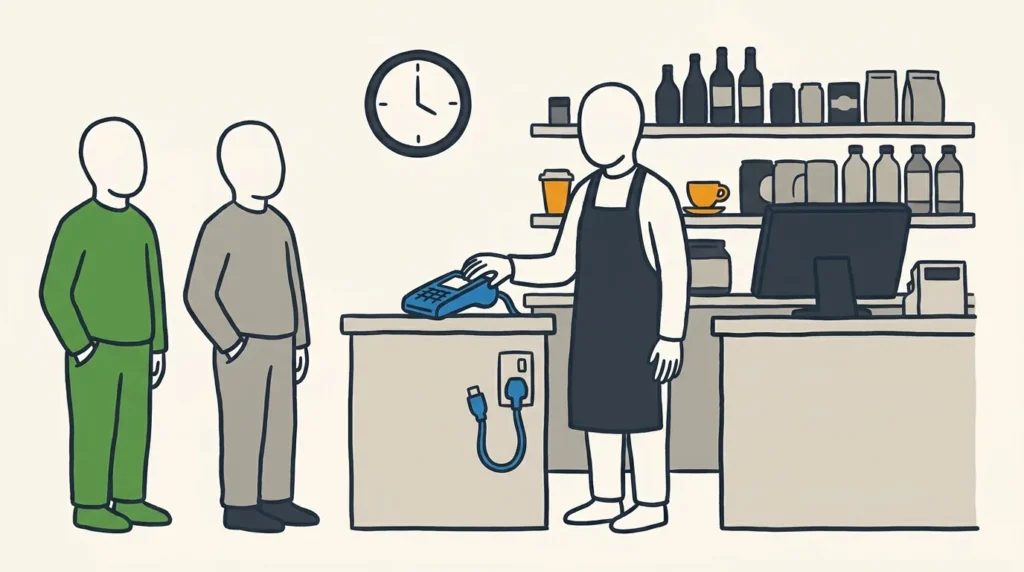
It usually starts with something small. The broadband drops, and within seconds the card machine, the booking system and the email all go with it. A customer is standing at the counter waiting to pay. An order cannot be taken, an invoice cannot be raised, and the morning quietly stalls while someone gets on the phone to the provider. Most owners have lived some version of this. The harder question is what it actually costs, and that turns out to be a great deal less obvious than the internet would have anyone believe.
What downtime actually means for a small firm
Downtime is easy to picture as the website being offline, but for most small businesses the website is the least of it. The real exposure sits in the systems the day-to-day work runs on: taking orders and payments, raising invoices, booking jobs, and staying reachable by phone and email. When connectivity or a core system goes down, several of those usually go at once, because they increasingly share the same broadband line and the same handful of cloud tools.
That is why a short outage rarely feels like one problem. It feels like the whole front of the business going quiet at the same time. Understanding the cost means looking past the website to the work that simply cannot happen while the lights are out.
Why there is no single cost of downtime number
Anyone searching for the cost of downtime will find confident figures that do not agree with each other. One source quotes a cost per minute, another a cost per hour, and the numbers sit orders of magnitude apart with no shared definition underneath them. That disagreement is not a reason to distrust the topic. It is the topic.
A single headline figure for what downtime costs a small business does not exist, because the cost depends entirely on the firm. It turns on how much revenue depends on systems being up, how many people are sitting idle while they are down, and how quickly the work can be recovered once they return. A busy e-commerce shop and a quiet workshop can lose the same hour of connectivity and one barely notices while the other loses a day’s takings. So rather than offer another number that would not survive contact with a real business, the useful thing is a method: the few figures that genuinely do exist, and then how to work out a firm’s own exposure from its own numbers.
What the UK data does tell us
Two pieces of UK data are worth standing on, and both predate any vendor-blog guesswork.
The first measures internet downtime specifically. Across 2023, UK businesses lost an estimated 50.5 million hours to internet failures, at an estimated cost of GBP 3.7 billion 1. The median cost to an individual business was around GBP 1,600 1. The detail that matters most for a smaller firm is in the breakdown by size: small businesses of 11 to 50 staff lost more hours, on average, than the largest enterprises did. It is not the big companies who fare worst here.
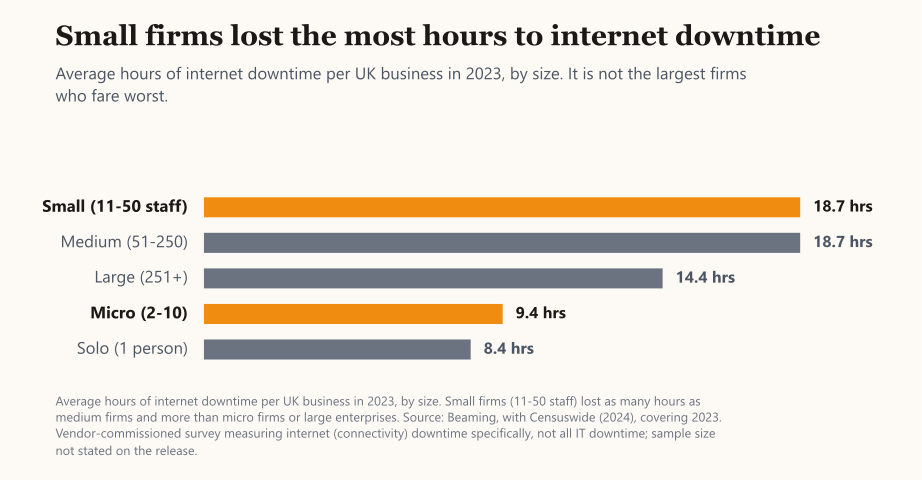
Average hours of internet downtime per UK business in 2023, by size. Small firms (11-50 staff) lost as many hours as medium firms and more than micro firms or large enterprises. Source: Beaming, with Censuswide (2024), covering 2023.
The second piece of data comes from the UK Government rather than a vendor, and it sizes one particular cause of downtime: a cyber breach. The Cyber Security Breaches Survey 2024 found that the single most disruptive breach of the previous twelve months cost the average business of any size around GBP 1,205 2. That figure includes a great many incidents with no real impact, though. Once only breaches with a material outcome are counted, the average cost of the most disruptive one rises to roughly GBP 6,940 2. Both numbers are honest, and the gap between them is the point: most incidents cost little, and the ones that actually break something cost a lot more. It is worth being precise about what this figure is. It is the cost of a breach, which is one cause of downtime among several, not a general downtime number, so it sits alongside the connectivity data rather than replacing it.
How to work out your own number
The reason no single figure fits is that downtime cost is built from four parts, and every business weighs them differently. The standard way to size it adds up lost revenue, lost productivity, the cost to recover, and the harder-to-measure cost to reputation 3.
Lost revenue is the income that does not arrive while the systems are down: the share of each revenue stream that depends on being online, summed up and multiplied by the hours lost. Lost productivity is the wage cost of people who cannot do their work, again weighted by how much of their job depends on the systems being up. The cost to recover is the time and effort to get everything back to normal once service returns, which is rarely instant. The cost to reputation is the enquiry that went to a competitor and the customer who quietly decided not to come back.
A worked example shows how much the answer moves. These figures are illustrative, chosen to be plausible for a small firm rather than measured from any one business. Take a firm that bills around GBP 200 an hour and where, say, three-quarters of the day’s revenue genuinely depends on systems being up. A two-hour outage in the busy part of the day costs roughly GBP 300 in revenue alone, before a penny of lost wages or recovery time is added. Change the firm and the figure changes with it: a workshop that takes most of its money in cash over the counter loses far less from the same two hours, because far less of its revenue depends on uptime. The method is the deliverable here, not the total. A firm that knows its own revenue-per-hour and the share of its work that depends on systems can size its own exposure in a few minutes, which is worth far more than a borrowed average.
The half of the cost the number hides
Even a careful sum tends to understate the cost, because some of it hides in places that are easy to overlook.
The first is short outages. Losses tend not to register until an outage has run for around six hours 1, which makes brief blips feel free. They are not. They simply scatter the cost across missed enquiries and small delays that never get totted up. The second is recovery: getting fully back to normal usually takes longer than the outage itself, and that catch-up time is real cost that the headline duration never shows. The third is reputation, the enquiry lost and the impression left, which is genuine but hard to pin to a figure, so it is better named than invented.
And for some firms there is no grace period at all. Around 15% of UK businesses begin losing money the moment connectivity fails, and roughly 39% would lose money from an eight-hour outage 1. For those businesses, resilience is not a refinement. It is the difference between a normal day and a day that does not happen.
Worth a closer look
The point of all this is not a frightening number. It is a clear-eyed one, worked from a firm’s own figures, that shows where the exposure really sits. Reducing that exposure, by making the systems a business depends on more dependable in the first place, is a problem hirevolution spends a lot of its time on.
See how hirevolution keeps the systems a business runs on dependable
Sources
- Beaming, with Censuswide, ‘GBP 3.7bn: the cost of internet failures to UK businesses’ (survey of UK businesses, fieldwork early 2024, covering calendar year 2023), published 2024. Vendor-commissioned survey; sample size not stated on the release; headline figures corroborated by independent coverage (IT Pro, ISPreview). [link]
- Department for Science, Innovation & Technology with the Home Office, ‘Cyber Security Breaches Survey 2024’ (official statistics; quantitative fieldwork winter 2023/24, Ipsos), published 9 April 2024. [link]
- ConnectWise, ‘How to calculate the cost of downtime’ (used for the lost-revenue + lost-productivity + recovery + reputation method only, not for any statistic). [link]