What slow quote follow-up really costs a trade business
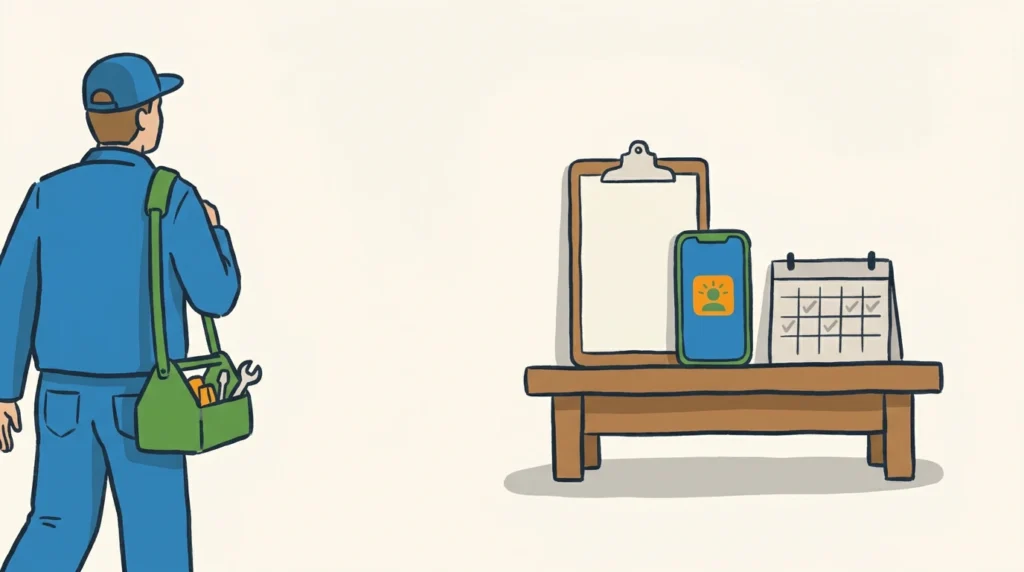
A tradesperson goes out, measures up, has a good chat on the doorstep, and sends a tidy quote that evening. It is a fair price for honest work, and the customer seemed keen. Then the week fills up, the next jobs land, and the quote sits where it was sent. No reply comes back, so it slips quietly down the list. A fortnight later the customer has had the work done by someone else, and the only thought that registers is that the price must have been too high. Usually it was not the price. It was the silence after the quote went out.
The expensive part of quoting is rarely the quote itself. It is what happens, or does not happen, in the days that follow. A missed call is a job that never started a conversation. This is the opposite case: the conversation started, the effort of visiting and pricing was already spent, and the work was still lost. Understanding why is worth a little time, because the fix costs far less than the leak.
Why a quote needs chasing at all
It is tempting to assume a good quote sells itself. If the customer wants the work and the price is fair, surely they will get back in touch. In practice they often do not, and not because they have lost interest. They are busy too. They asked two or three trades for a price, they are waiting to compare, the job is not urgent enough to chase, or life simply gets in the way. A quote with no follow-up relies entirely on the customer doing the remembering. Most will not.
Sales circles have long traded a tidy set of figures on this, usually along the lines that most sales are only made after the fifth contact while most sellers give up after the first 1. Those particular numbers are best treated with caution: they get repeated everywhere without any robust study behind them, so they are folklore rather than evidence. What they point at, though, is real and easy to recognise on any van dashboard: the work tends to go to whoever stays in touch, and staying in touch is exactly the part that slips when the days are full. A quote that is sent and then left alone is leaning on the least reliable step of all, which is the customer remembering to come back.
Where the quote goes cold
There is a second reason an un-chased quote leaks work, and it is about speed as much as persistence. When a customer is comparing trades, the early replies carry more weight than the late ones. The most detailed evidence on response speed comes from a study of inbound enquiries by Dr James Oldroyd, then at MIT, with InsideSales.com. It found that responding within five minutes rather than thirty made contacting the enquirer roughly a hundred times more likely, and qualifying it around twenty-one times more likely 2. That study looked at online sales leads in 2007, not trade quotes, so it is best read as evidence about response speed in general rather than a precise multiplier for a plumber’s estimate. The direction is the part that travels: the longer a reply takes, the colder the enquiry gets, and a quote left to sit is the slowest reply of all.
The same instinct shows up in how customers behave on the phone. In a survey of 1,000 UK businesses, 69% of callers who reached voicemail hung up without leaving a message, and 42% were calling because they needed an urgent response 3. People asking for work want a person, and they want one soon. A quote that is sent and then goes quiet asks the customer to be the patient one, at exactly the moment they are weighing up someone else who replied faster.
So a cold quote is not usually a rejected quote. It is an unanswered one, and the silence is doing the rejecting.
The maths most trades never sit down with
The way to make this real is to turn it into money using a business’s own numbers, not a borrowed percentage. Here is a worked example. The figures are illustrative, chosen to be plausible for a small trade rather than measured from any one firm, so the method matters more than the total.
Take a business that sends 20 quotes in a month. Each one already cost something to produce: the drive to site, the time measuring up, the evening spent pricing it properly. Suppose, without any deliberate follow-up, 6 of those 20 convert. That is a 30% win rate, which is respectable for cold quoting.
Now suppose a simple, prompt follow-up lifts that win rate by a third, so 8 quotes convert instead of 6. That is not a heroic improvement, and it is a deliberately modest assumption rather than a measured result. It is the sort of lift that one timely message and one polite chase a few days later can plausibly produce, given how rarely quotes get chased at all. The two extra jobs are the ones that were already won on the doorstep and then lost to silence.
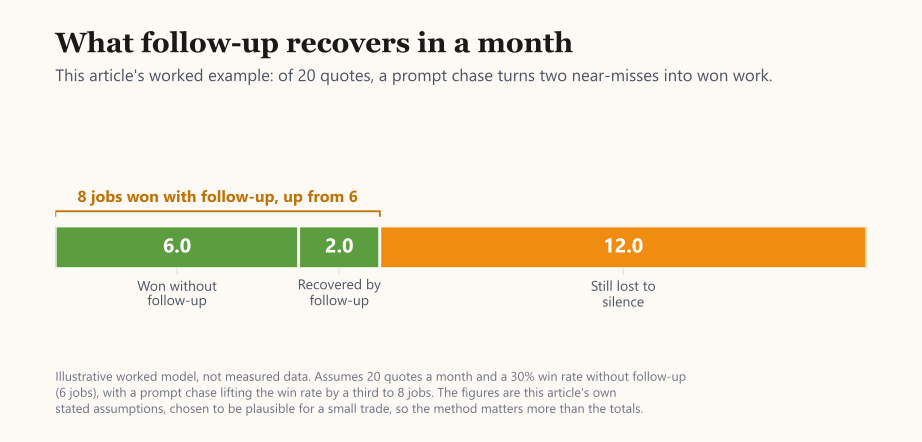
Illustrative worked model from this article’s own stated assumptions, not measured data: of 20 quotes a month, a prompt follow-up recovers two near-misses, lifting won work from 6 to 8. The method matters more than the totals.
Put a value on those two jobs. A plumber’s call-out in the UK runs around £110, with a day’s work closer to £350 4. If each recovered job is worth somewhere between a single call-out and a day’s labour, two extra jobs a month is roughly £220 to £700 recovered every month, which is several thousand pounds a year. The number swings with every assumption, which is the honest point: it is a leak sized by the business’s own quote volume, win rate, and job value, not a headline figure that applies to everyone. The method is the takeaway. Count the quotes, be honest about the win rate, and ask what one extra job a month is worth.
And the worked sum understates it, because it only counts the first job. A first job that never happens is also the repeat work that never follows and the referral the customer never makes, because they became someone else’s customer instead. That tail is real but hard to pin to a number, so it is better named than invented.
Why the chasing does not happen
None of this means tradespeople are careless. The follow-up does not happen because the moment for it lands at the worst possible time. The quote goes out in the evening after a full day, and the chase is due three or four days later, by which point there is a new site, a new pile of quotes to write, and the last batch has already faded from mind. Following up well means remembering, on the right day, every single quote that has not had an answer. That is an admin job, and admin is what gets dropped first when the work is physical and the day is long.
The usual fallback is to wait and hope, or to rely on the customer to call back. Both lean on the customer doing the remembering, which, going on how these jobs tend to play out, they mostly will not. Trying harder does not fix this either, because the limit is not effort. It is that nobody on a small team has the headspace to track every open quote by hand while also doing the actual work. The useful question is not how to be more disciplined about chasing, which has a ceiling, but how to make sure no issued quote is left to go cold on its own.
What a different approach looks like
Closing this gap is less about chasing harder and more about making sure no quote falls silent by default. In practice that means three things. Every quote that goes out is tracked, so an unanswered one is visible rather than forgotten. A prompt, personal follow-up goes back to the customer within a day or two, while the doorstep conversation is still fresh, rather than a fortnight later when the decision has been made. And a gentle second nudge follows if there is still no reply, because a comparison decision is often made days after the quote lands rather than the moment it arrives.
Done by hand, that is a real burden on a small team. Done with a simple system behind it, it is mostly automatic: the quote is logged, the reminders fire on the right days, and the messages go out in the business’s own voice, so the owner only steps in when there is an actual reply to deal with. The point is not to nag customers. It is to stop work that was already half-won from quietly slipping away in the silence after a quote.
This is the part hirevolution helps with: keeping track of the quotes a busy team cannot chase by hand, and getting a prompt, personal follow-up back to the customer, so a fair quote stops going cold on the dashboard of the van.
Worth a closer look
See how hirevolution approaches missed calls and lead handling
Sources
- ILLUSTRATIVE / UNVERIFIED. The often-repeated sales-blog cluster (‘80% of sales are made on the fifth-to-twelfth contact; 48% never follow up; 44% give up after one’) is widely circulated, for example by The Marketing Donut, but traces back to no robust primary study (the original ‘National Sales Executive Association’ attribution is unsubstantiated and widely debunked). Cited here only as commonly-repeated sales folklore that nonetheless points at a real, observable behaviour gap, not as established fact. [link]
- Lead Response Management study, Dr James Oldroyd (then MIT / Kellogg), with InsideSales.com, 2007. Analysis of inbound web leads; found roughly a 100-fold increase in the odds of contacting a lead, and a 21-fold increase in the odds of qualifying it, when responding within 5 minutes rather than 30. [link]
- Moneypenny / Censuswide, ‘The Value of a Call Report’ (survey of 1,000 UK businesses), 2019 (69% who reach voicemail hang up without leaving a message; 42% call needing an urgent response). [link]
- Checkatrade plumber cost guide, 2026 (illustrative UK call-out and day-rate figures). [link]