What it really costs to run a small business on six disconnected tools
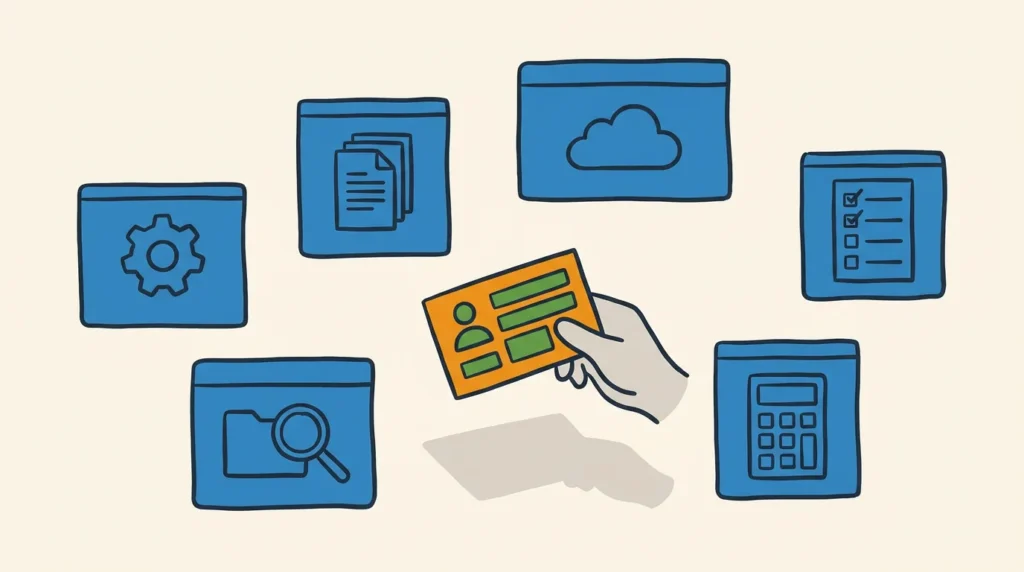
Nobody sets out to run a business on six disconnected tools. It arrives one sensible decision at a time. A CRM to keep track of customers. A separate app for quotes. A spreadsheet for the bits neither one covers. An inbox, an accounting package, a scheduling tool. Each was the right call on the day it was bought, and each does its own job perfectly well. The cost is not in any one of them. It is in the gaps between them, where the same customer detail gets typed in three times, and a few seconds of reorientation gets paid every single time someone jumps from one screen to the next. It never appears on an invoice, which is exactly why it is worth sitting down and adding up.
The tax nobody put on the invoice
The bills for the tools themselves are easy to see. They turn up monthly, they have a number on them, and a careful owner can tot them up in an afternoon. The expensive part is the part with no line item: the human time spent ferrying information between systems that were never introduced to each other.
It looks harmless in the moment. A name copied from the inbox into the CRM. A quote total re-keyed into the accounts. A job checked against a spreadsheet because that is the only place the full picture lives. None of it takes long on its own. The problem is that it happens dozens of times a day, for every person, and it is the kind of work that produces nothing. The customer is no better served for having been typed in three times rather than once. That is the tax: real time, paid repeatedly, for movement rather than progress.
How much time actually goes between the tools
There is good research on how much of this goes on, though it is worth being upfront about where it comes from. The most detailed study tracked 137 people across three large companies for up to five weeks, watching how often they switched between applications. The answer was about 1,200 times a day. Stitched back together, the few seconds of reorientation paid after each switch added up to just under four hours a week, or roughly 9% of time at work, spent simply finding the thread again after moving between tools 1.
Put in plainer terms, that is around two seconds lost per switch, and across a year it works out at roughly five working weeks per person spent reorienting rather than doing the actual job 1. One example from the same dataset makes the point vivid: a single supply-chain task involved around 350 switches between 22 different applications and websites 1.
Two caveats matter, and keeping them in view is the point of citing the source at all. This is United States data, drawn from large enterprises rather than small British firms, so it is best read as a proxy rather than a measurement of any specific small business. And it counts only one slice of the problem: the time lost reorienting after a switch, not the wider business of re-keying and chasing. It is a floor on one part of the tax, not the whole bill.
It is not just switching, it is doing the work twice
Switching is only the visible half. The deeper cost is that disconnected tools quietly push people into doing the same work more than once.
A separate survey of more than 9,600 knowledge workers across six countries, including the UK, found that people use around ten apps a day, and that roughly 60% of their time goes on what the researchers called work about work: coordinating, searching for information, switching between tools, and chasing the status of things, rather than the skilled work they were hired for 2. The same study found that the more apps a team runs, the more work gets missed and duplicated. Messages get lost between systems, actions fall through the gaps, and the same thing gets done twice because no single place shows it was already handled.
It is tempting to add the two findings together, but they should not be summed. The 9% lost to switching and the 60% spent on work about work are two lenses on the same problem, not two separate bills. The honest reading is simpler than a precise total: a meaningful share of every working day, across a lot of people, goes on moving and re-checking information rather than serving customers.
Turning hours into money for a small UK firm
Hours are easier to ignore than pounds, so it helps to convert. The conversion is deliberately transparent, built from two cited inputs so anyone can check it or swap in their own numbers.
Start with the four hours a week lost to reorientation 1. Annualised at 46 working weeks, allowing around six weeks for holidays and bank holidays, that is 184 hours a year per person. The 46-week assumption is an author’s choice, not the study’s, and it is on the cautious side. Apply the UK median full-time hourly wage, excluding overtime, of £18.64 in April 2024 3, and the cost lands at roughly £3,430 per person per year. For a six-person firm, that is around £20,580 a year.
Because the toggle figure is a proxy, it is fairer to show a conservative version alongside it. Halve the published switching time to two hours a week, and the cost falls to about £1,715 per person, or roughly £10,290 a year for the same six-person firm. Even at half the published rate, the number is in the thousands per person and the tens of thousands per small team.
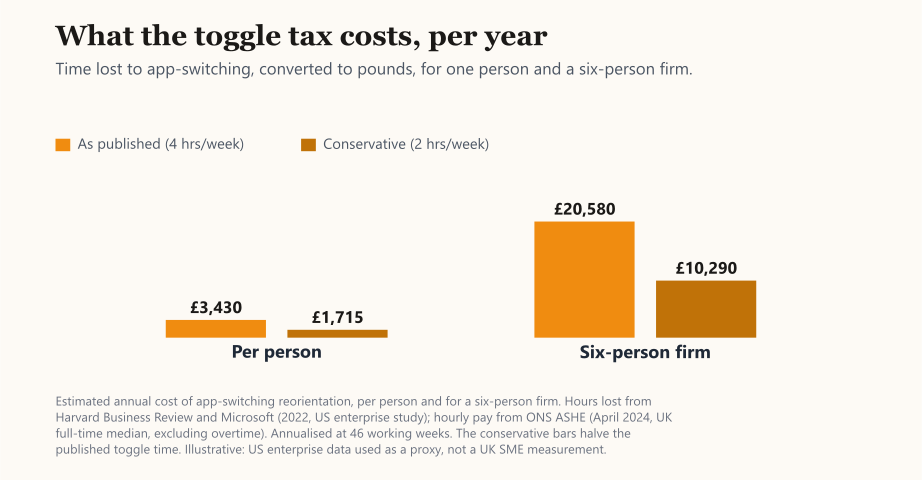
Estimated annual cost of app-switching reorientation, per person and for a six-person firm. Hours lost from Harvard Business Review and Microsoft (2022, US enterprise study); hourly pay from ONS ASHE (April 2024, UK full-time median, excluding overtime). Annualised at 46 working weeks. The conservative bars halve the published toggle time. Illustrative: US enterprise data used as a proxy, not a UK SME measurement.
The chart is an order-of-magnitude illustration, not a to-the-pound forecast. The toggle study is US enterprise data used as a proxy, the wage is a single UK median applied evenly, and the figure captures only reorientation, not re-keying or duplicated work. The honest claim is not a precise total. It is that the gaps between disconnected tools cost a small firm thousands of pounds a year in time that never shows up as a cost.
The UK picture, on the ground
UK-specific evidence on this exact problem is thinner, but it points the same way. Older research into small-business admin found that UK firms were losing around 120 working hours a year to admin, with about 5.6% of staff time going on back-office tasks for want of proper systems 4. The same work estimated that closing the productivity gap could add tens of billions to UK output. Those figures date from 2017, so they are directional rather than current, and admin is not quite the same thing as tool-switching. The two overlap without being identical: switching is part of admin, but admin also covers re-keying, chasing, and reconciliation that the toggle studies do not measure.
Taken together, the picture is consistent across very different sources and dates. Whether the lens is application-switching, work about work, or back-office admin, a substantial slice of small-firm time goes on the friction between systems rather than the work itself.
What actually moves the number
The instinct, faced with all this, is to go looking for one tool to replace the six. Sometimes that is right. More often it is not, because consolidation for its own sake means abandoning tools that do their individual jobs well and forcing the business to relearn everything at once. The lever that actually moves the number is connection, not consolidation: closing the gaps between the tools already in use, so information passes between them without a person carrying it by hand.
In practice that means the small, repetitive transfers are the first things to remove. A new enquiry in the inbox creating the customer record automatically, rather than someone copying it across. A quote flowing into the accounts without being re-typed. A single view that shows whether something has been handled, so it does not get done twice. None of this is glamorous, and none of it requires ripping anything out. It is the quiet plumbing between systems, and it is where the re-keying and the copy-paste, the most wasteful part of the tax, can be designed away.
That is the ground hirevolution works on: connecting the tools a small business already runs on, and automating the joins between them, so the time that currently leaks into the gaps goes back into the work.
Worth a closer look
Sources
- Harvard Business Review, ‘How Much Time and Energy Do We Waste Toggling Between Applications?’, August 2022 (study of 20 teams / 137 users across three Fortune 500 companies, up to five weeks; ~1,200 switches a day, just under four hours a week reorienting, roughly 9% of time at work). [link]
- Asana, Anatomy of Work Global Index 2023, released 8 March 2023 (survey of 9,615 knowledge workers across the US, UK, Australia, France, Germany and Japan; ~10 apps a day; ~60% of time on ‘work about work’; more apps correlate with more missed and duplicated work). [link]
- Office for National Statistics, Employee earnings in the UK: 2024 (ASHE), released 29 October 2024 (median gross hourly earnings excluding overtime for full-time employees = £18.64, April 2024). [link]
- Sage UK SME admin-burden research (‘Sweating the Small Stuff’ lineage), reported by SmallBusiness.co.uk, 14 September 2017 (UK small businesses spend ~120 working hours a year on admin; ~5.6% of staff time on back-office tasks for want of systems; closing the gap could add £33.9bn to UK GDP). Older figures, used as UK directional corroboration only. [link]