AI for small businesses: what's actually working, and what's still hype

There is a particular kind of tired that comes from reading about AI. Every week brings a headline that says it will transform the business, replace half the team, or leave anyone who hesitates behind. The next week brings a different headline saying it is a bubble that delivers nothing. For an owner with a business to run, neither one is much help. The useful question is quieter than either: of all the things AI is supposed to do for a small business, which ones are actually working today, and which are still mostly talk?
It turns out there are reasonably good answers to that, and they are more encouraging and less dramatic than the headlines on either side.
What most small businesses are actually doing
Start with how many businesses are using AI at all, because the picture is calmer than the noise suggests. The Department for Science, Innovation and Technology surveyed 3,500 UK businesses in 2025 and found that around 1 in 6, about 16%, were using at least one AI technology, while 80% were neither using it nor planning to 1. A separate YouGov poll of 1,000 smaller firms put current use higher, at 31%, with adoption concentrated in IT, telecoms and marketing and trailing well behind in trades-heavy sectors such as construction, transport and hospitality 2. The two numbers differ because they ask slightly different questions of slightly different businesses, but they agree on the shape: meaningful use, not universal use, and very uneven across sectors.
What stands out more than the headline rate is what the adopters are actually using it for. Among businesses that use AI, 85% are using it for natural-language work, which means writing and rewriting text, summarising, drafting and answering questions 1. The most common areas inside the business are marketing and administration, both at 72%, then IT 1. By contrast, the more futuristic category, so-called agentic AI that acts on its own across a workflow, was used by just 7% of adopters 1. The everyday reality of AI in a small business in 2026 is far closer to a very capable writing and admin assistant than to an autonomous workforce.
What’s genuinely working
Two things are working well enough to be worth taking seriously.
The first is time. Three quarters of UK businesses using AI, 75%, reported improved workforce productivity, and 56% reported a rise in their employees’ overall output 1. That is a self-reported figure, so treat it as a strong signal rather than a precise measurement, but it is consistent across a large sample. The wins are unglamorous and that is exactly why they hold up: a first draft of a quote or a customer email written in a tenth of the time, a long thread summarised before a call, a policy or a proposal turned around in an afternoon instead of over a week. None of that makes a headline. All of it gives an owner back the one resource a small business never has enough of.
The second is that the best returns tend to come from the back office, not the shop window. The MIT NANDA study of AI in business found that more than half of corporate AI budgets went into sales and marketing tools, yet the clearest returns showed up in back-office automation: cutting the cost of routine processing, handling, and administrative work 3. That study looked at larger US and global organisations rather than UK SMEs, so it is a pointer rather than direct proof for a small British firm. But the lesson travels well, because the unglamorous internal jobs, the chasing, the logging, the tidying of data, are exactly the work a small team most wants off its plate.
What’s still mostly hype
The same research is just as clear about where the promises are running ahead of reality.
The most striking finding came from that MIT study, which reported that around 95% of generative-AI pilots delivered no measurable return, while roughly 5% drove real revenue gains 3. Taken at face value that sounds like proof the whole thing is a bubble. It is more interesting than that, and the detail is the part worth keeping. The researchers were clear that the failures were not caused by the AI models being poor. They were caused by what the report called a learning gap: tools dropped into a business that never adapted to how that business actually works, bought to look busy rather than to do a defined job 3. The same study found that buying a focused tool from a specialist and partnering on it succeeded about 67% of the time, while building something in-house succeeded only about a third as often 3. The hype is not that AI does nothing. The hype is that buying AI, in the abstract, does something on its own.
The revenue story tells the same cautionary tale closer to home. While three quarters of UK adopters reported better productivity, 77% had not yet seen any change in revenue at all, and only 12% reported revenue going up 1. Better productivity is real. The idea that it converts straight into a bigger top line, quickly and automatically, is not yet borne out.
Real, but not magic
Put the two halves together and a sensible position falls out. AI is helping the businesses that use it, mostly by saving time on writing and admin, and the clearest returns sit in the routine internal work. It is not, for most firms, moving the revenue line yet, and the projects that fail tend to fail because a tool was bought without a job to do.
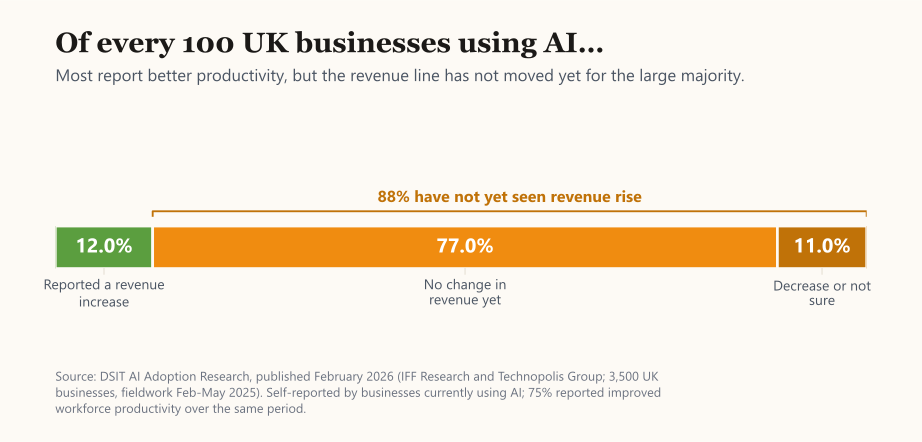
Of UK businesses using AI, most report better productivity, but the revenue line has not moved yet for the large majority. Source: DSIT AI Adoption Research, February 2026.
The chart above is the whole argument in one bar. The productivity gain is genuine and widely felt. The revenue jump that the loudest marketing implies is, for the large majority, simply not there yet. Both things are true at once, and holding both is what separates a useful read of AI from a credulous or a cynical one.
There is one more pattern in the UK data worth sitting with, because it explains a lot of the disappointment. When businesses were asked why they had not adopted AI, the two most common reasons were not cost or fear. They were a lack of any identified need and limited skills to apply it 1. That is the quiet truth under the noise. The firms getting value are not the ones that bought the most AI. They are the ones that started from a specific, irritating job, a stack of quotes to draft, an inbox that never empties, a report assembled by hand every month, and found the tool that fitted it. The ones that bought AI because the headlines said to are the ones still wondering what it was for. It is also worth noting that 67% of UK adopters keep significant human checking on AI outputs, which is the right instinct: the tool drafts, a person still decides 1.
So the honest answer to what is working and what is hype is less a verdict than a method. Pick the job before the tool. Start with the dull, repeatable work rather than the visible, clever-looking work. Expect time back before you expect revenue. Keep a person in the loop. Used that way, AI is one of the more genuinely useful things to arrive for a small business in years, which is a quieter claim than the headlines make, and a good deal more likely to be true.
For anyone weighing where a first sensible step might sit in their own business, hirevolution’s view on getting value from AI starts from the same place: the job first, the tool second.
Sources
- DSIT, AI Adoption Research, published 13 February 2026 (IFF Research and Technopolis Group; survey of 3,500 UK businesses with 5+ employees, fieldwork 12 Feb to 2 May 2025, plus 100 qualitative interviews). [link]
- YouGov, We polled UK SME leaders about AI adoption, 7 August 2025 (1,000 UK SME decision-makers, up to 250 employees, fieldwork 14-21 July 2025). [link]
- MIT NANDA initiative, The GenAI Divide: State of AI in Business 2025 (150 leader interviews, 350-employee survey, 300 public AI deployments). Reported in Fortune, 18 August 2025. US and global enterprise data, not UK SME-specific. [link]