What a customer portal can replace (and what it cannot)
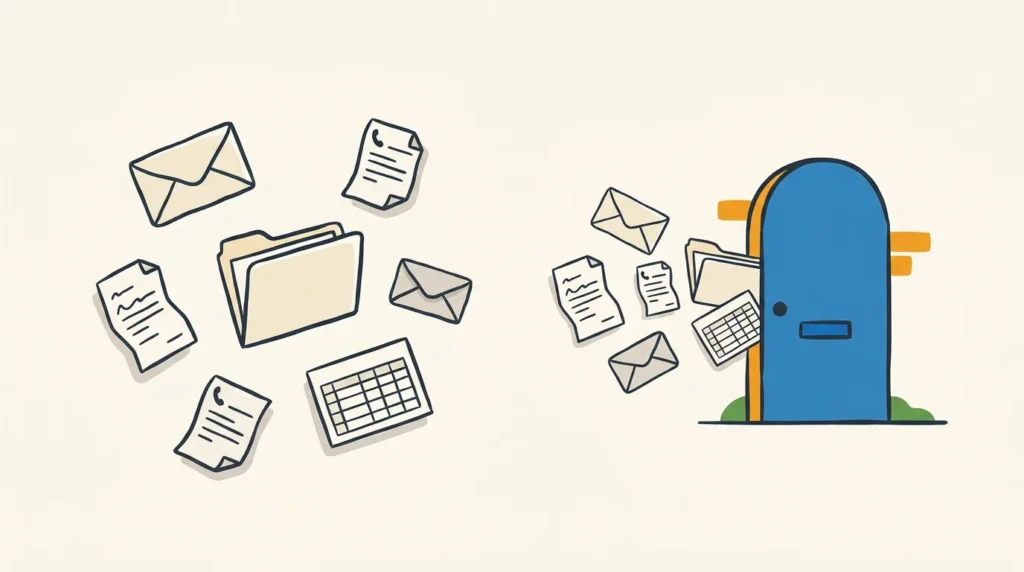
A customer portal usually starts as a feeling rather than a plan. It is the inbox full of “any update?” emails, the same five documents requested for the fourth time, the invoice resent because the first two went unread. None of it is hard work. That is exactly what makes it draining: it is structured, repeatable back-and-forth that a person keeps having to do by hand, and it never quite stops. The useful question is not whether a portal would be nice to have. It is which of those exchanges a portal can genuinely take off a person’s desk, and which still need a human no matter how good the software is.
The work a portal is actually for
It helps to be precise about what a customer portal is. Strip away the marketing and it is a single, secure place where a customer can see the status of their own work, exchange documents, and handle their own transactions, without having to ask a person for each one. That is the whole idea: turning a series of one-to-one requests into something the customer can serve themselves.
The reason that matters is that a surprising share of small-business time goes on precisely this kind of administration. UK research puts the average small business at around 24 working days a year lost to financial admin alone, which the researchers framed memorably as working 13 months to get paid for 12 2. That figure is vendor research without a published sample, so it is best read as colour rather than a hard count. The point it illustrates is sound: a lot of the day disappears into structured exchanges, and structured exchanges are the one thing software is genuinely good at absorbing.
So a portal is not a customer-service strategy and it is not a website. It is a machine for removing a specific category of work. The task is to work out how much of that category a business actually has.
What it genuinely replaces
A portal earns its place by taking on the exchanges that are repeatable and have a clear shape. In practice that means a handful of things.
Status chasing. Most “any update?” messages exist only because the customer has no other way to see where their order, job, or case has got to. Put that status somewhere they can check on demand, and the question stops being asked. The work was never the answer; it was the interruption.
Document collection and exchange. The classic case is an accountancy practice gathering year-end records, VAT paperwork, and identity documents for anti-money-laundering checks. Done by email, it is a chase that runs for weeks. Done through a portal, the customer uploads once, the files are versioned and traceable, and signatures can be collected in the same place. The chasing shrinks to a reminder.
Form re-keying and intake. When a customer fills in their own details once, in a structured form that feeds straight into the systems behind it, nobody has to retype them off an email or a scribbled note. That removes both the typing and the transcription errors that come with it.
Self-serve answers to recurring questions. The questions a business answers ten times a week (“what do you need from me”, “how does the process work”, “where do I find my invoice”) can sit as answers the customer reaches without a reply being written.
Invoices, statements, and payment. Giving a customer on-demand access to their own invoices and a way to settle them removes a quietly expensive loop. The cost of that loop is not small in the UK: 22% of businesses report spending staff time chasing late payments, at an average of 86 hours a year for each business affected, which adds up to roughly 133 million hours across the economy 1. The same research estimates late payment costs the UK economy almost £11 billion a year and contributes to around 38 business closures every day 1. Not all of that is solved by a portal. But the part that is pure chasing, the resending and the reminding, is exactly the kind of structured exchange a billing surface is built to absorb.
The common thread is worth naming. Every one of these is repeatable, has a predictable shape, and currently costs a person’s attention each time it recurs. That is the pile a portal can take.
What it cannot replace
The honest version of the pitch names the other side of the line just as clearly. A portal is a form of self-service, and the evidence on self-service is blunt about its ceiling.
Gartner, surveying 5,728 customers, found that only 14% of customer-service issues are fully resolved in self-service 4. Even for issues customers themselves described as “very simple”, the figure only reached 36% 4. The reasons are concrete rather than mysterious: people found the tools too rigid for the actual shape of their problem, 43% could not locate the relevant content, and 45% felt the company had not understood what they needed 4. (That research is about customer-service self-service specifically, which overlaps with but is not identical to a portal; read it as evidence about the “answer my question” part of a portal, not the document-and-payment part.)
What this maps to is a clear category of work that stays human. Anything that needs judgement: a quote that depends on a site nobody has seen yet, a case with an exception the form did not anticipate. Anything that involves negotiation. Anything where the customer is upset, anxious, or out of their depth, and what they actually need is the reassurance of a person. And anything genuinely novel, where the situation has no template because it has never come up before.
A portal does not make these go away, and it should not pretend to. Its job with this pile is different: to clear the path to a person, not to stand in for one. The best portals make the route to a human one obvious click, not a maze.
The trap: a bad portal costs more, not less
There is a failure mode worth understanding before building anything, because it is the one that turns a sensible investment into a frustrating one.
It is true that most customers would rather sort things out themselves first. The widely cited figure is that around 81% try to handle a matter on their own before reaching a person 3. (That is a US-origin industry benchmark, useful as framing rather than a precise UK number.) So the appetite for self-service is real, and that is the case for building a portal in the first place.
The trap is what happens when self-service half-works. If a customer tries the portal, cannot resolve their issue, and then cannot easily reach a person, they do not give up. They bounce: they ring, then email, then ring again, increasingly annoyed, until they finally reach someone. And by then the interaction costs far more than it would have if they had reached a person at the start. Gartner’s earlier work put the cost of a live interaction, even as one step after a failed self-service attempt, at an order of magnitude more than a clean self-service fix 5. The lesson is not that self-service fails to pay off. It is that it only pays off when the handoff to a human is clean. A portal that hides the exit does not save money. It adds a frustrating detour on top of the cost it was meant to avoid.
A simple test: sort your own interactions into two piles
The decision does not need a consultant or a spreadsheet to start. It needs one honest sort of the work a business already does, into two piles.
Pile one is the portal candidate. An interaction belongs here if it is repeatable, has a predictable shape, and is about status, documents, forms, recurring answers, or payment. These are the exchanges the earlier sections covered: the ones where the customer mostly wants information or wants to hand something over, and a person is currently the bottleneck rather than the value.
Pile two stays human. An interaction belongs here if it needs judgement, context, negotiation, or empathy, or if it is genuinely new. The portal’s job for this pile is not to replace the person but to make reaching them effortless: one clear, obvious route, never buried.
Then look at the size of pile one. That, not the appeal of the technology, is what decides whether a portal is worth building. If the repeatable exchanges are a steady, growing share of the day, a portal will return the time it costs to build. If they are occasional, the honest answer may be that a tidier inbox and a shared folder are enough for now. Either way, the decision is grounded in a business’s own volume rather than a brochure.
Worth a closer look
Sources
- Late Payments Research: Estimating the total economic cost of late payments and their impact on the UK economy, London Economics for the Department for Business and Trade and the Office of the Small Business Commissioner, July 2025. [link]
- Sage research, 2025, surfaced in the Barclays and Sage partnership announcement (vendor research; no published sample or methodology, treat as illustrative). [link]
- Dixon, Ponomareff, Turner and DeLisi, ‘Kick-Ass Customer Service’, Harvard Business Review, January to February 2017 (industry benchmark; US-origin authors, global framing). [link]
- Gartner survey of 5,728 customers, conducted December 2023, published 19 August 2024. [link]
- Gartner, September 2019, based on studies of more than 8,000 customer journeys (the 80 to 100x cost figure is from 2019, read as an order of magnitude not a current exact multiple). [link]